

quinta-feira, 30 de abril de 2015

quinta-feira, 23 de abril de 2015
Lancamento de do livro "A Inocência das Facas"
A Cruz Vermelha Portuguesa Delegação da Trofa,
vem por este meio convidá-lo a partilhar mais um momento da nossa
Delegação, o lançamento de um novo livro alusivo à temática da violência
intitulado - A Inocência das Facas.
A apresentação terá lugar dia 2 de Maio pelas 16 horas na Livraria Papa Livros no Porto.

23 de Abril - Dia Mundial do Livro

A UNESCO instituiu em 1995 o Dia Mundial do Livro.
A data foi escolhida por ser um dia importante para a literatura mundial - foi a 23 de Abril de 1616 que faleceu Miguel de Cervantes e a 23 de Abril de 1899 que nasceu Vladimir Nabokov.
O dia 23 de abril é também recordado como o dia em que nasceu e morreu o escritor inglês William Shakespeare.
A data serve ainda para chamar a atenção para a importância do livro como bem cultural, essencial para o desenvolvimento da literacia e desenvolvimento económico.
Pessoalmente considero que a data também pode chamar a atenção para a importância do livro como um bem fundamental para o desenvolvimento SUSTENTÁVEL!
quinta-feira, 16 de abril de 2015

sexta-feira, 10 de abril de 2015
Wine corkscrews !
First noted in the 1680's, wine corkscrews were first created by blacksmiths as a variation of a musket barrel cleaning tool
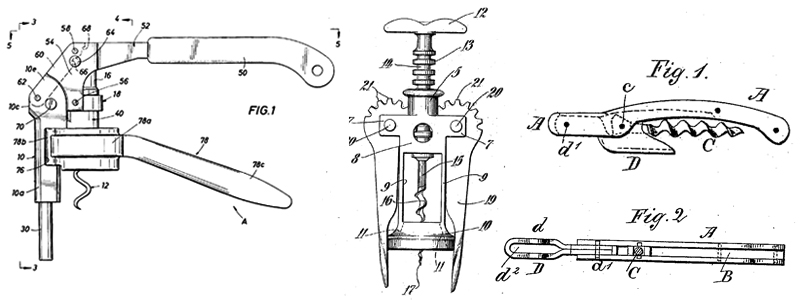 The corkscrew, like so many other inventions, was borne out of
necessity. For as long as we have sold wine in glass bottles sealed with
cork stoppers, consumers have struggled to easily remove those corks.
As soon as the earliest glass bottles arrived in late
seventeenth-century England, inventors began dreaming up instruments to
ease the removal of corks.
The corkscrew, like so many other inventions, was borne out of
necessity. For as long as we have sold wine in glass bottles sealed with
cork stoppers, consumers have struggled to easily remove those corks.
As soon as the earliest glass bottles arrived in late
seventeenth-century England, inventors began dreaming up instruments to
ease the removal of corks.
The earliest reference to a corkscrew was noted in the 1680s. These crude instruments — “steel worms” — were variations on musket barrel cleaning tools (gun worms) manufactured by gunsmiths. Over the next 300 years inventors would file hundreds of patents, relentlessly improving upon these first adapted corkscrews. Here’s a brief history of the most important advances.
Henshall’s corkscrew was so effective that it was used widely for over 100 years. Cork enthusiasts – helixophiles — claim that while Henshall may have patented the design, he likely was not its inventor, as similar models were made by others decades earlier.
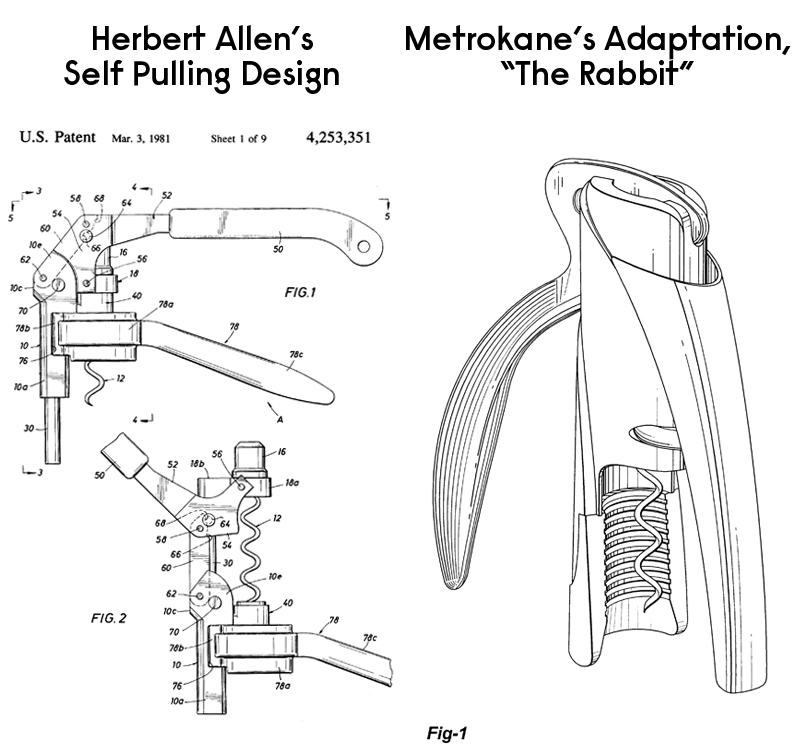
Herbert Allen earned another patent for a single side lever corkscrew, which employed a down–up–down series of strokes to dive into the cork, pull it out, and then slip off the screw. The “Rabbit” made this type of corkscrew famous among American consumers, as an extremely easy-to-use, if pricey way to reliably remove corks.
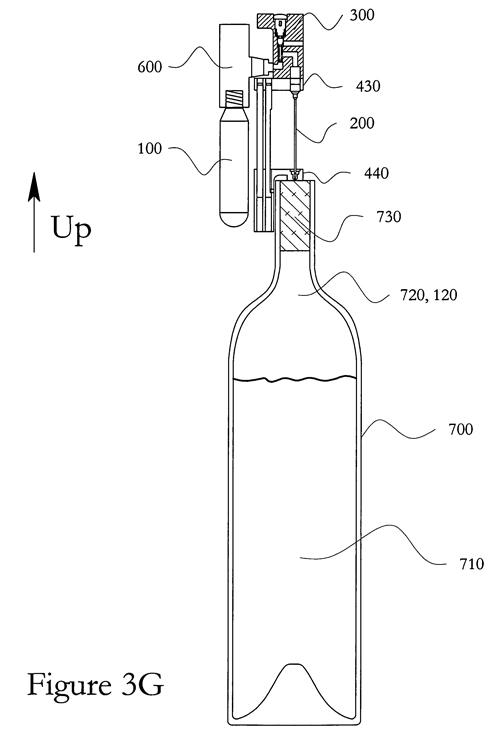
 What does the future hold? Perhaps one day the idea of removing corks
will seem alien to us, at least for expensive bottles we’d like to
drink in more than one sitting. The Coravin uses a syringe and inert gas
to allow wine to be removed from a bottle without ever extracting the
cork, or allowing oxygen to enter. For now the Coravin is only popular
among wine bars with pricey “by-the-glass” programs and wine enthusiasts
who own expensive bottles, which they don’t intend to drink in a single
session or over a couple of days.
What does the future hold? Perhaps one day the idea of removing corks
will seem alien to us, at least for expensive bottles we’d like to
drink in more than one sitting. The Coravin uses a syringe and inert gas
to allow wine to be removed from a bottle without ever extracting the
cork, or allowing oxygen to enter. For now the Coravin is only popular
among wine bars with pricey “by-the-glass” programs and wine enthusiasts
who own expensive bottles, which they don’t intend to drink in a single
session or over a couple of days.
Fonte: 100% Cork
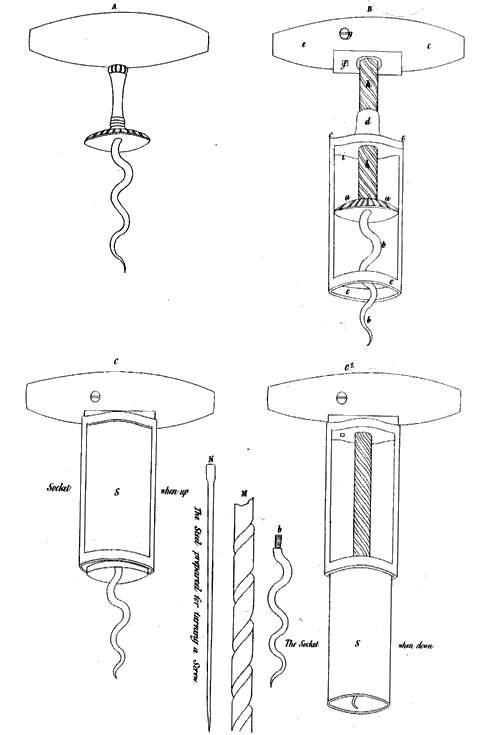
The earliest reference to a corkscrew was noted in the 1680s. These crude instruments — “steel worms” — were variations on musket barrel cleaning tools (gun worms) manufactured by gunsmiths. Over the next 300 years inventors would file hundreds of patents, relentlessly improving upon these first adapted corkscrews. Here’s a brief history of the most important advances.
The First Patented Corkscrew
Reverend Samuel Henshall received the world’s first patent for a corkscrew in 1795. Henshall, a religious official in Oxford, England, collaborated with Mathew Boulton, a prominent manufacturer in Birmingham, to bring his corkscrew to the market. Henshall’s key improvement on the wooden-handled steel worm was the insertion of a concave disk between the handle and the worm. The disk served two purposes: it prevents its user from screwing too deep into the cork and it forces the cork itself to turn once that limit is reached, breaking any seal between the cork and the glass neck.Henshall’s corkscrew was so effective that it was used widely for over 100 years. Cork enthusiasts – helixophiles — claim that while Henshall may have patented the design, he likely was not its inventor, as similar models were made by others decades earlier.
Samuel Hanshell’s Patent For A Corkscrew via The Quarterly Worme – Granted 1795
Inventing The Single Direction Twist
The next key innovation in corkscrew design can be traced to another Englishman, Edward Thompson. Thompson, in an 1802 patent, documented a way to allow a user to turn the corkscrew in a single direction by employing nested screws, which turn in opposite directions. When one screw reached its limit, a second screw engaged, allowing the cork to begin its move upward. This design element made its way into many other corkscrew designs, including the famous “Zig-Zag” corkscrew.The Waiter’s Friend
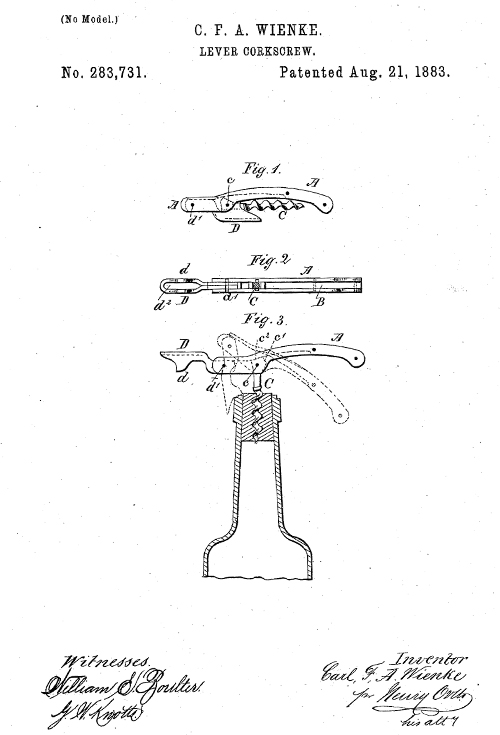
In 1882, German inventor Carl F.A. Wienke, filed a patent on the “Waiter’s Friend,” also known as a “Butler’s Friend” and a “Wine Key.” This slim, foldable corkscrew (in a shape similar to a pocket knife — earning it yet another name, the “Sommelier’s Knife”) employs a screw and a single lever. The Waiter’s Friend’s handle uses the side of the wine bottle for leverage, easing the upward pull of the cork. While this design has seen many improvements — the double hinged levers of the “Pull-Tap” prominent among them — its basic form has proved its worth, as the myriad variations remain extremely popular both with restaurant and bar professionals and home wine drinkers alike.
The U.S. Patent Filing For Carl FA Wienke’s Lever Corkscrew – Granted 1883
The Wing
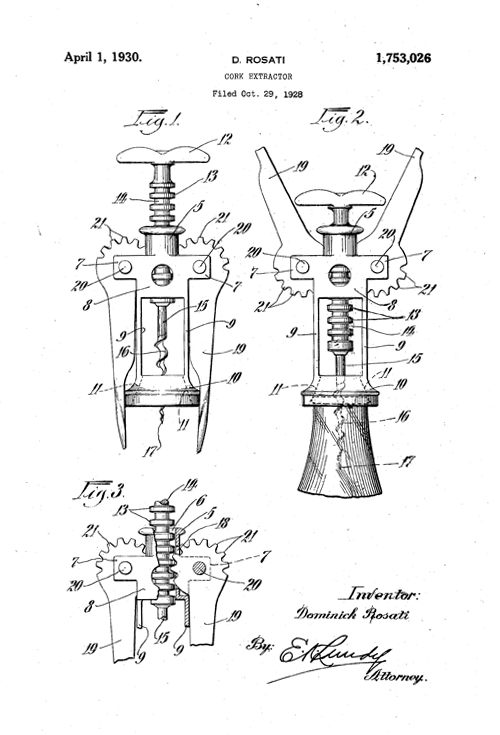
The double-lever, rack-and-pinion “Wing” corkscrew has its origins in H.S. Heely’s 1888 British patent on a corkscrew he called the A1 Heeley Double Lever. A version of this corkscrew reached the United States in 1930. Patented to Italian designer Dominick Rosati, the design remains quite popular. As you twist the screw into the cork, a pair of levers rise on each side of the bottle’s neck. When you push the levers down the cork rises. When crafted out of heavier, thicker metal it can be easy to use and quite effective. Cheap, flimsier versions can be frustrating to use, as the leverage the corkscrew should provide just isn’t there.
The U.S. Patent Filing For Dominick Rosati’s Wing Corkscrew – Granted 1930
Modern Innovations
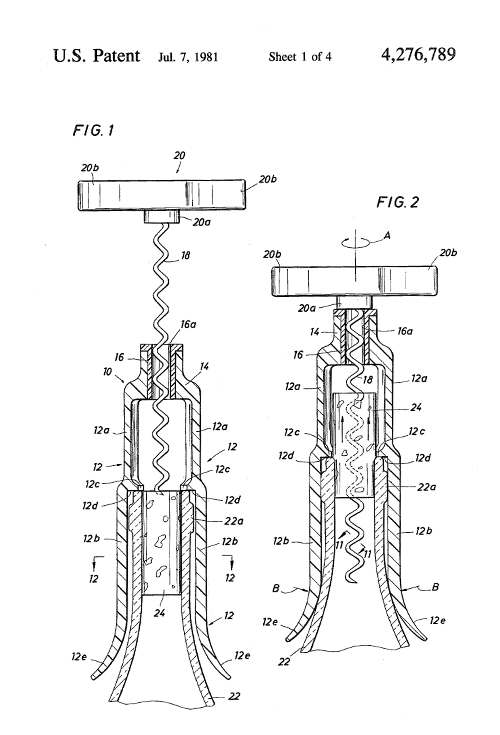
1979 saw the introduction of the “Screwpull” corkscrew, designed and patented by Herbert Allen, an oil and aerospace industry engineer who fell in love with wine while traveling through Europe in the 1950s. Allen used polycarbonate plastic and advanced metals to produce a corkscrew so elegant it found its way into The Museum of Modern Art’s permanent collection. The slim device wraps around the top of the bottle. To use it you simply turn the plastic screw.
Herbert Allen’s Screwpull Corkscrew – Granted 1981
Herbert Allen earned another patent for a single side lever corkscrew, which employed a down–up–down series of strokes to dive into the cork, pull it out, and then slip off the screw. The “Rabbit” made this type of corkscrew famous among American consumers, as an extremely easy-to-use, if pricey way to reliably remove corks.
Allen’s Self Pulling Corkscrew Patent And The Rabbit Patent For A Similar Device, Two Decades Later
quinta-feira, 9 de abril de 2015


quarta-feira, 8 de abril de 2015
Regras ambientais são para cumprir - Ministro do Ambiente

O ministro do Ambiente afirmou que existem cerca de 3000 instalações que não cumprem integralmente as regras ambientais e terão de submeter os seus procedimentos de regularização até 2 Janeiro 2016. Fonte: Público
A verificação das regras ambientais aplicadas a uma instalação, é um processo que requer algum tempo, metodologias especificas e conhecimento.
Não espere pela data limite para implementar os respectivos procedimentos afectos ás regras ambientais aplicadas à sua instalação, contacte-me!

quinta-feira, 2 de abril de 2015
ROLHA QUE TRANSFORMA GARRAFAS EM CANDEEIROS

A Suck UK, uma empresa de acessórios de casa e brindes, desenvolveu uma rolha em cortiça que tem uma lâmpada LED incorporada. Para transformar as suas garrafas em candeeiros originais basta tapá-la com a rolha e ligar a lâmpada.
A rolha adapta-se a vários tipos de gargalos, o que permite o seu uso em quase todas as garrafas. Para recarregar a lâmpada basta ligar a entrada USB, que já vem incorporada, a um computador ou adaptador.
Como a lâmpada é neutra, quando ligada difunde a cor da garrafa, o que permite criar ambientes e jogos de cor.
Fonte:
Subscrever:
Comentários (Atom)